In 1898, at the initiative of the Russian Empire, a peace conference was convened at The Hague, its aim to head off the conflicts then gathering in Europe.
The Netherlands, so set on neutrality, liked Nicholas II's idea very much, and the first Hague conference was scheduled for his birthday, as a mark of respect to the Russian emperor who had pressed so insistently for peace to be kept and extended.
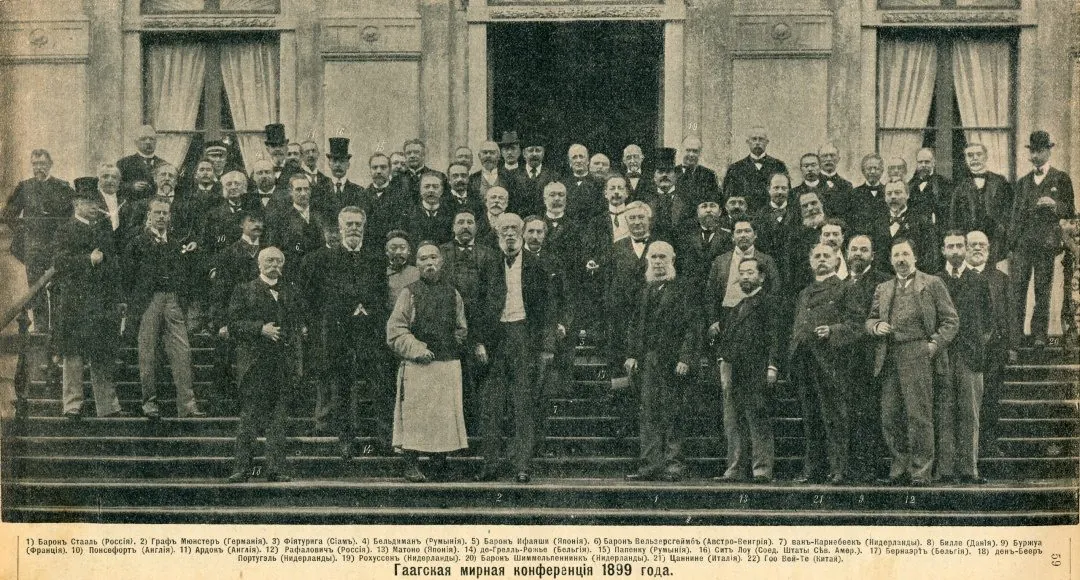
The First Hague Conference, 1899.
We know, of course, that every effort came to nothing, and that the First World War began in Europe in 1914.
On 28 July 1914, a month after the killing of Franz Ferdinand, heir to the Austro-Hungarian throne, at Sarajevo, the empire declared war on Serbia.
One of the hardest military conflicts in history had begun in Europe.
Today we are going to talk about the Netherlands, which wanted passionately to stay out of it.
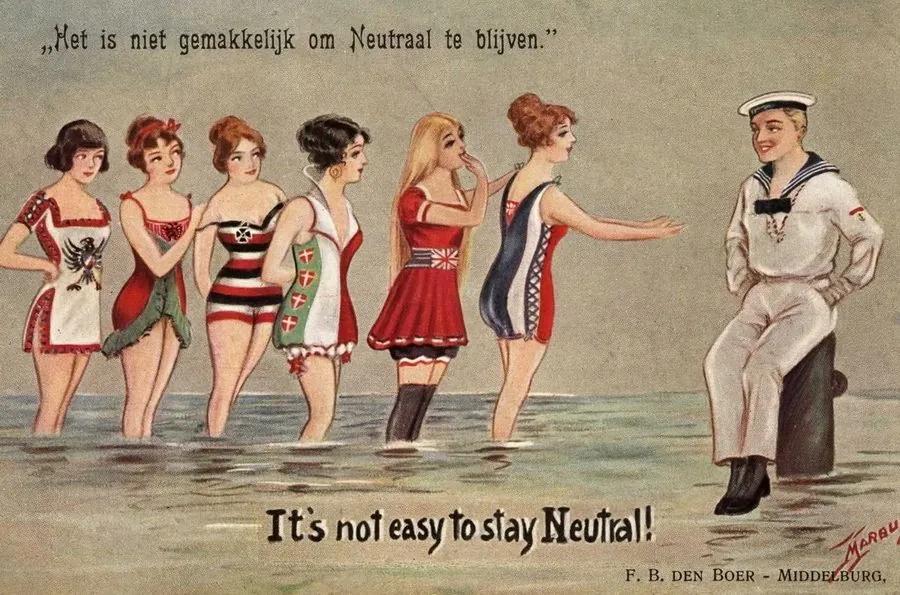
A caption to a cartoon showing the countries of Europe as beautiful young women and the Netherlands as a sailor: staying neutral — staying indifferent — is not easy.
Just a couple of days after Austria-Hungary's declaration, on 31 July 1914, seeing that there was no other way, the Netherlands ordered a general mobilisation.
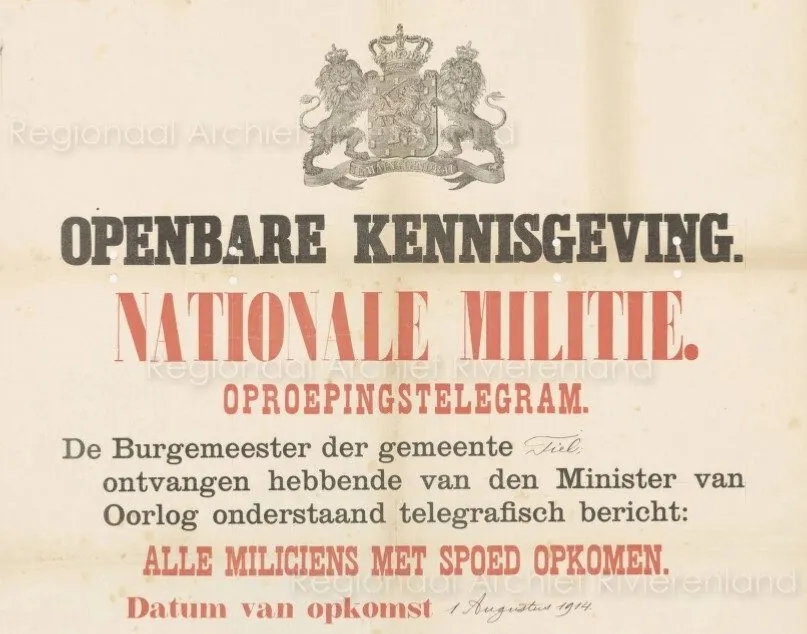
The mobilisation notice.
Both reservists and militia were called up.
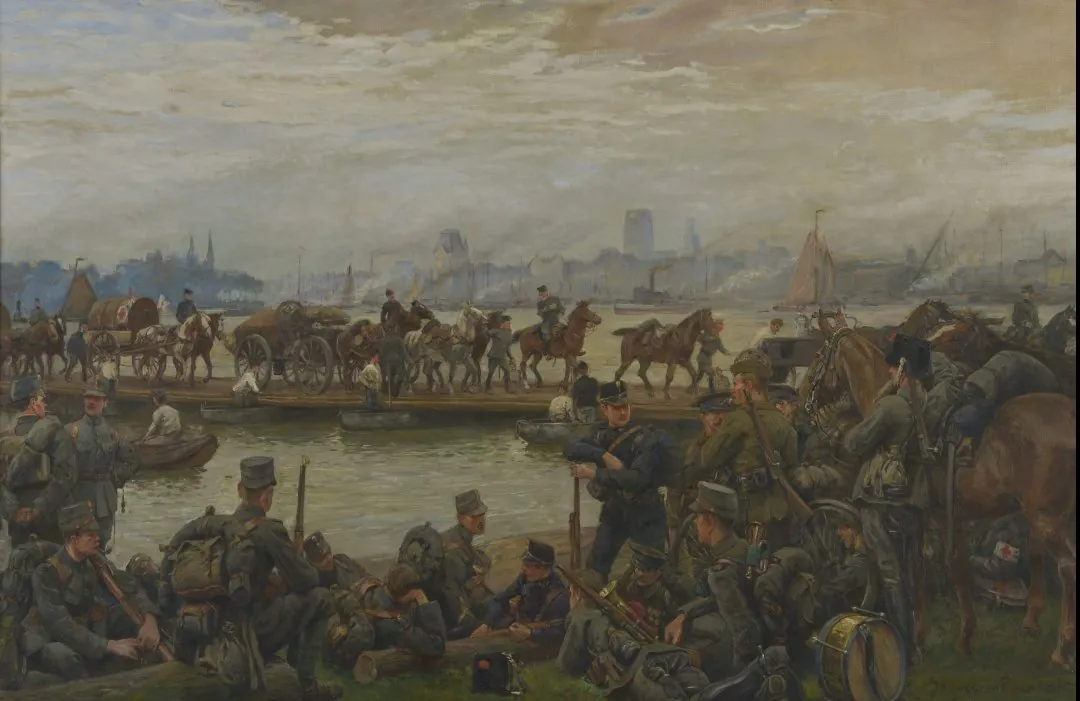
Dutch soldiers on exercise; a painting by Jan Hoynck van Papendrecht.
Soldiers not engaged in fighting were, frankly, bored. Not all of them, naturally — the ones on watch at the borders had no time for boredom.
But the town-based men, stationed nearer the centre, sometimes languished with nothing to do. Their commanders set them to sport and competitions and drew them into educational schemes. At times they had to deal with the mass of refugees from neighbouring Belgium: foreign servicemen had to be separated from civilians, the first sent to internment camps, the second to places where refugees were housed together.
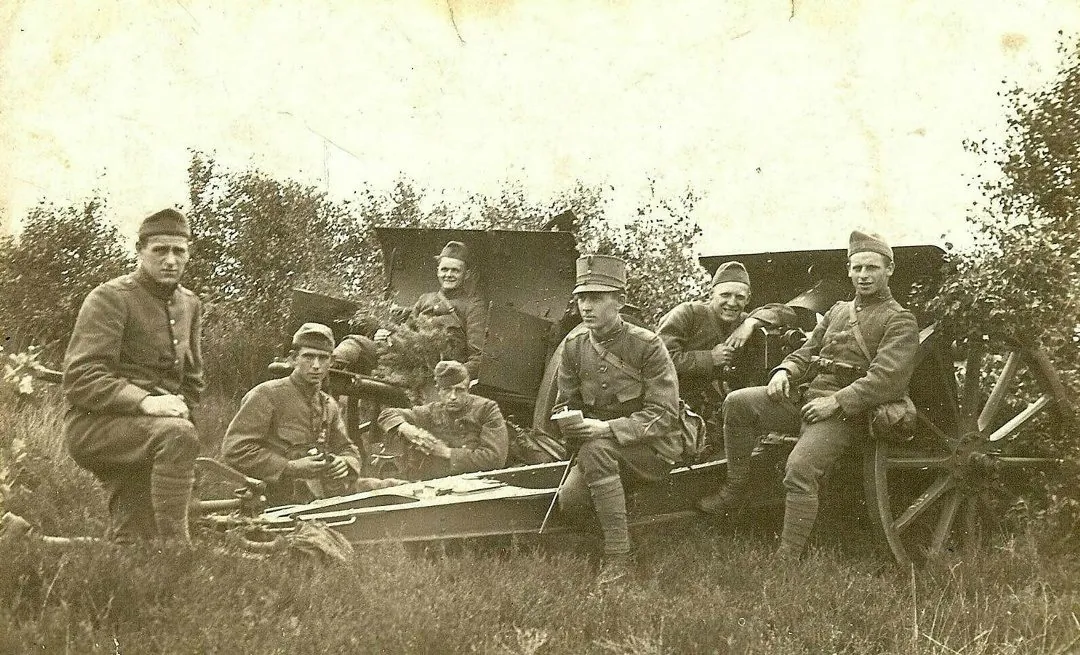
Dutch artillerymen in Brabant, 1914.
Naturally, a fresh market of bored men was a tempting prospect for enterprising fellow citizens. Souvenirs became popular — things meant to remind fiancées and sweethearts to wait for the men they loved. Or a girl might order some gift for her gallant soldier.
The cheapest and commonest souvenir was, of course, the postcard — often with jokey, faintly risqué scenes about relations between the sexes.
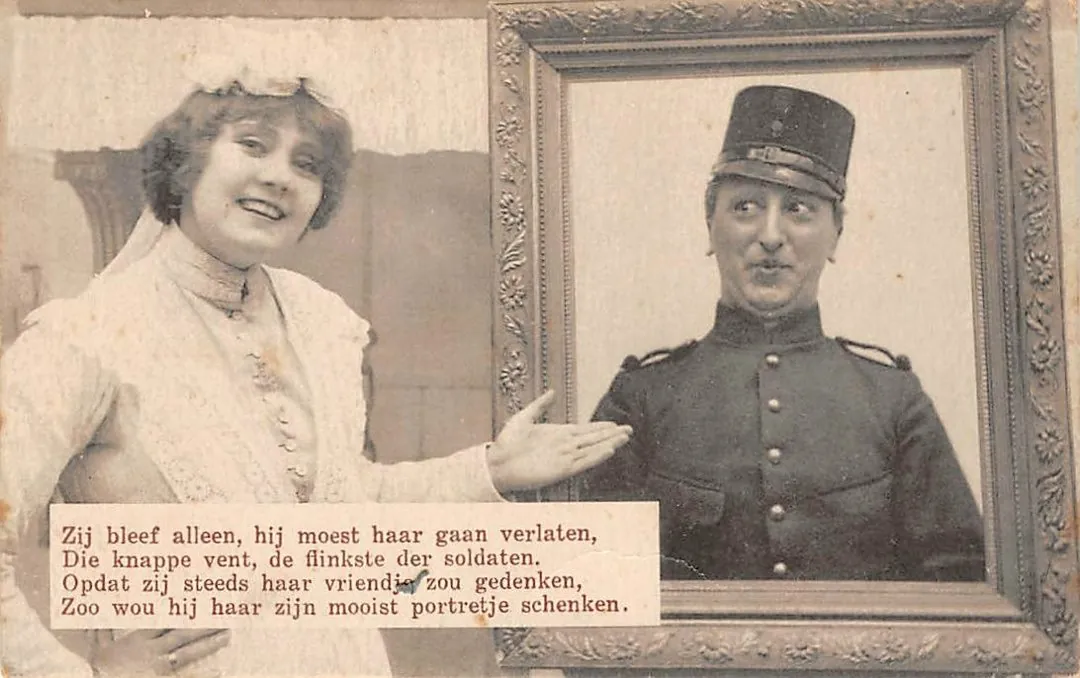
A postcard verse, freely rendered from the Dutch: she was left alone and he had to go; he was a handsome soldier and strong with it; and so that she would remember for ever what a hero looked like, he had his very finest portrait made.
At least half of those called up carried on living much as they had before.
Naturally, pulling men's hands away from their work told on the economy at once. War on the outside — and on the inside, who exactly was going to do the work?
Which is precisely why the authorities allowed many of the mobilised men to go back to their jobs.
They could work in town, of course, buy presents for the women they loved, and get on with any civilian business.
And this brings us to the heroine of this piece: a keepsake cup from a mobilised man.
The cup is a triptych — divided into three parts, and, as I understand it, they are meant to be read left to right, though the other way round works too.
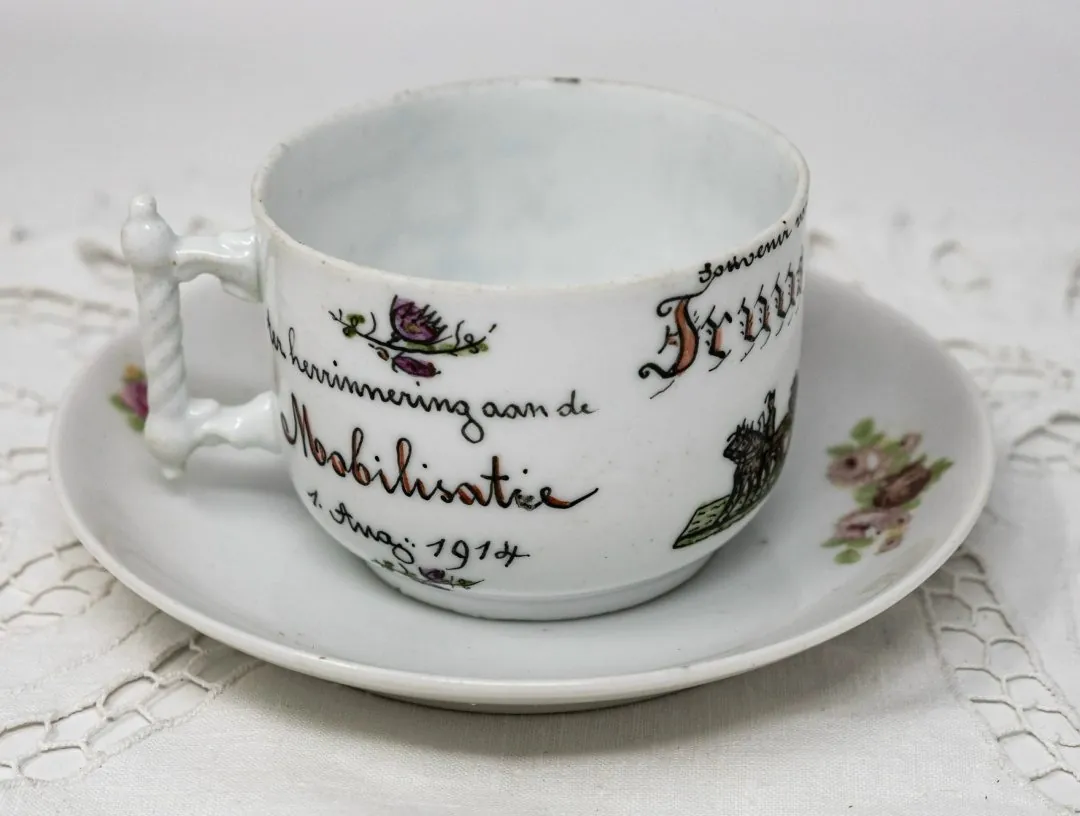
The left part of the inscription reads: in memory of the mobilisation of 1 August 1914. That is the simplest part of the painting. We now know the date, and the reason such a gift came to exist.
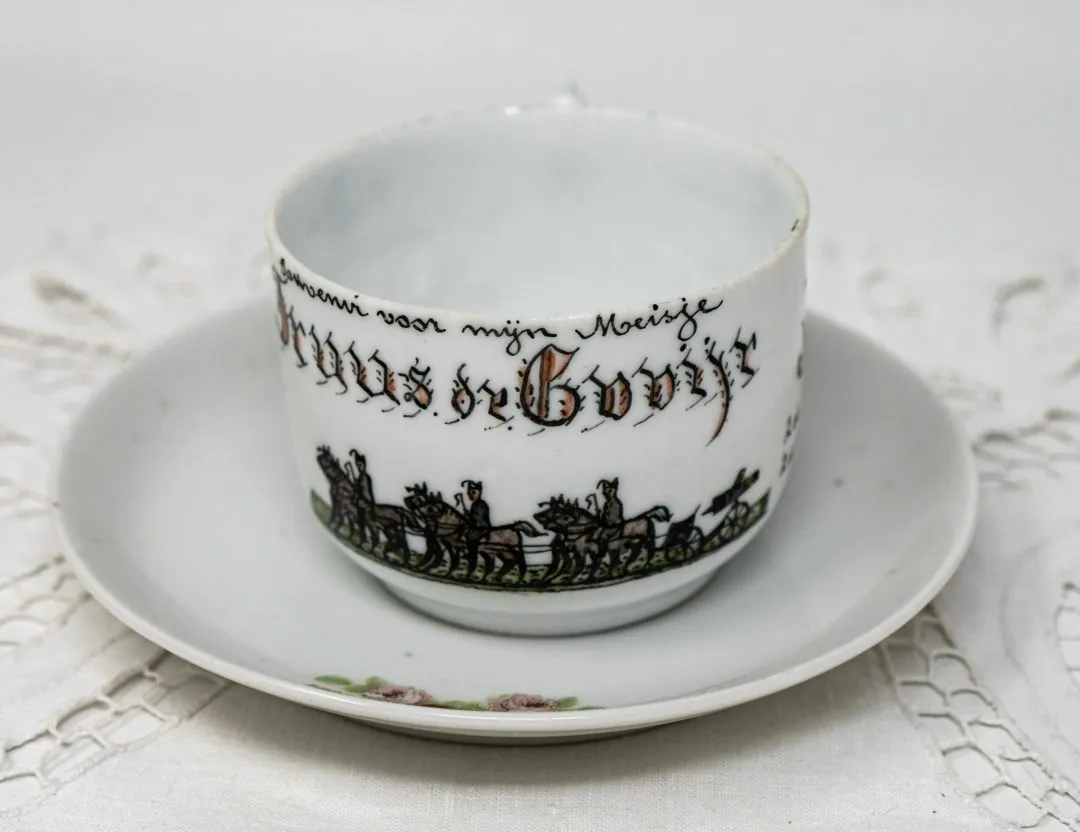
The central part reads "A souvenir for my girl", and then, in large gothic letters, "Truus de Booij(c)".
Here is the first snag. The standard, common Dutch surname ends in Booij, but here a "c" is hovering. So: the surname is de Booij, and the given name Truus is an affectionate diminutive of Geertruida — a certain "little Trudy de Booij", then.
The right-hand part of the cup is our gallant soldier's signature.
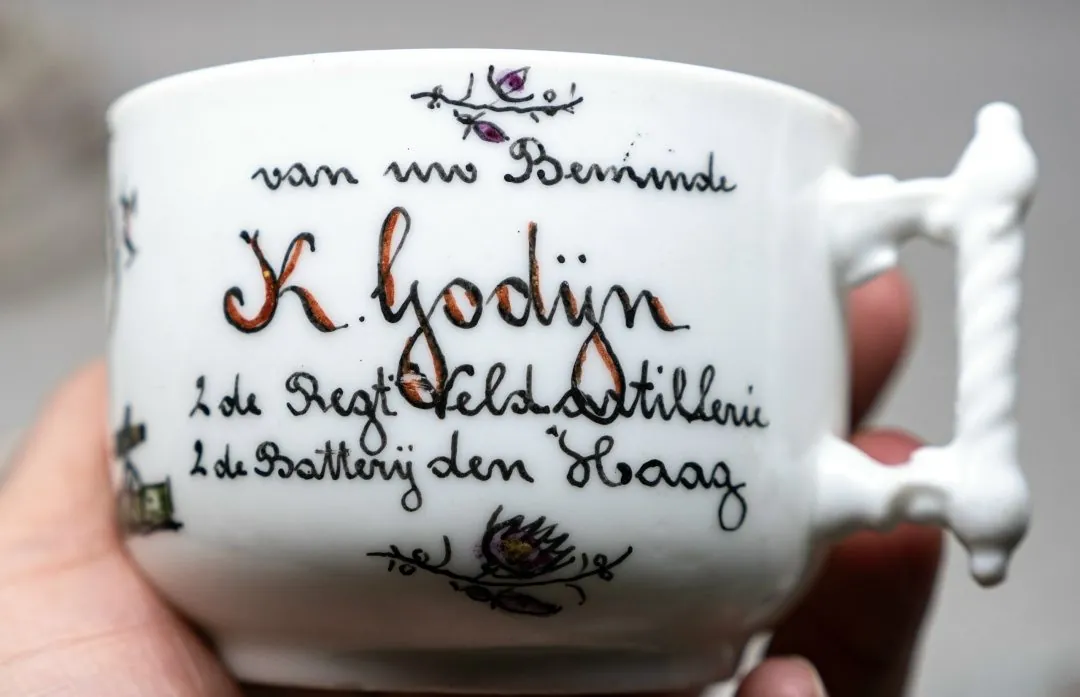
"From your beloved K. Godÿn, 2nd Field Artillery Regiment, 2nd Hague Battery."
So… where could a soldier have got hold of a tea duo like this? How did it actually work? Did he go to the market, buy a blank and paint it himself? Did he go into a souvenir shop and dictate the message?
How does one find out?
Searching the internet turned up nothing at all for souvenir tea duos of this kind. If a souvenir shop had been turning these out, even a plain image search would have given at least a few results. Can the cup really be the only one in the world?
Let us think it through. If mobilised men were released to work, then perhaps the man who sent his porcelain valentine home from the army simply worked at one of the manufactories.
But we all know that Dutch wares are nothing like this. Most manufactories made quasi-ceramic goods — apart from a handful you could count on one hand across whole centuries.
Across the years of the First World War, only one manufactory was operating in The Hague: Rozenburg, whose life ran from 1883 to 1917.
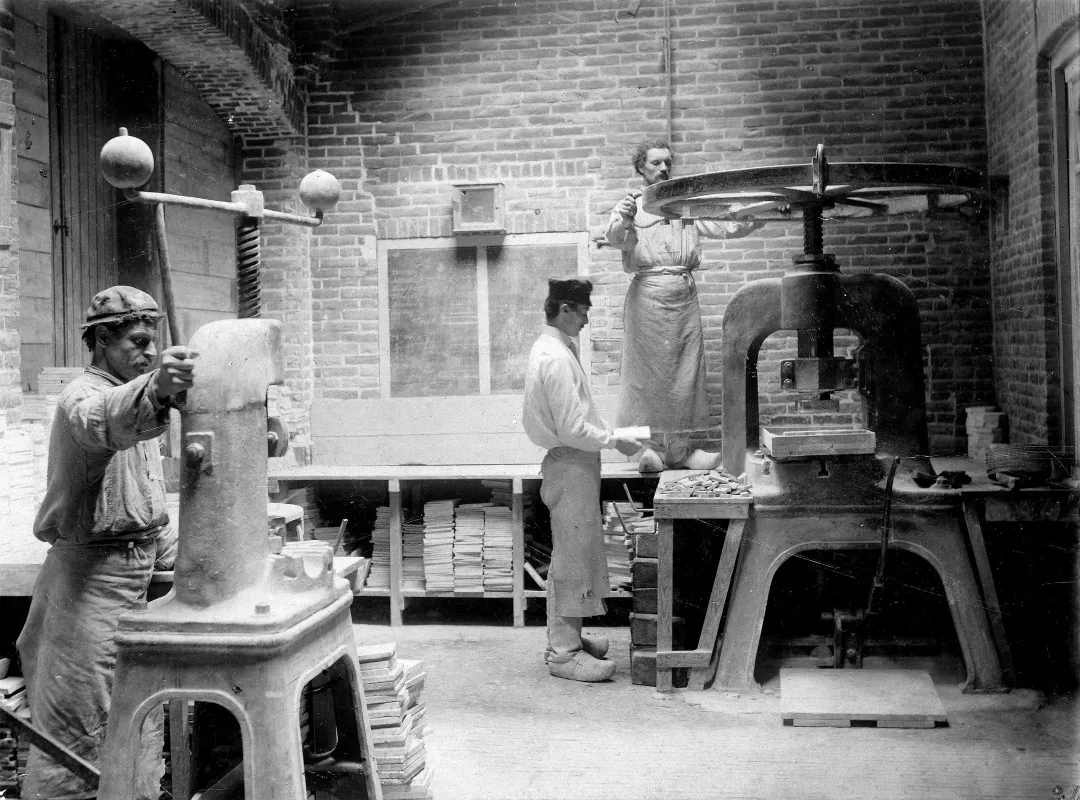
Workers at the Rozenburg manufactory.
It is, incidentally, one of the few manufactories making genuinely fine porcelain of the kind our cup is made from. And yet among its remarkable output no comparable forms have been found at all.
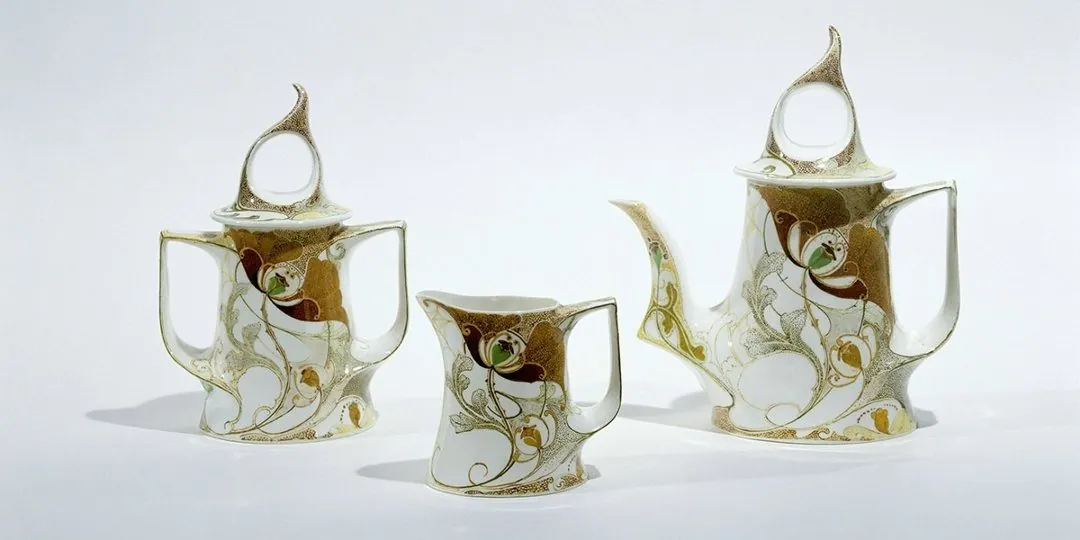
Superb examples of the art nouveau style.
So where could the gallant soldier have got it, and what is this magical "souvenir shop" with access to porcelain blanks?
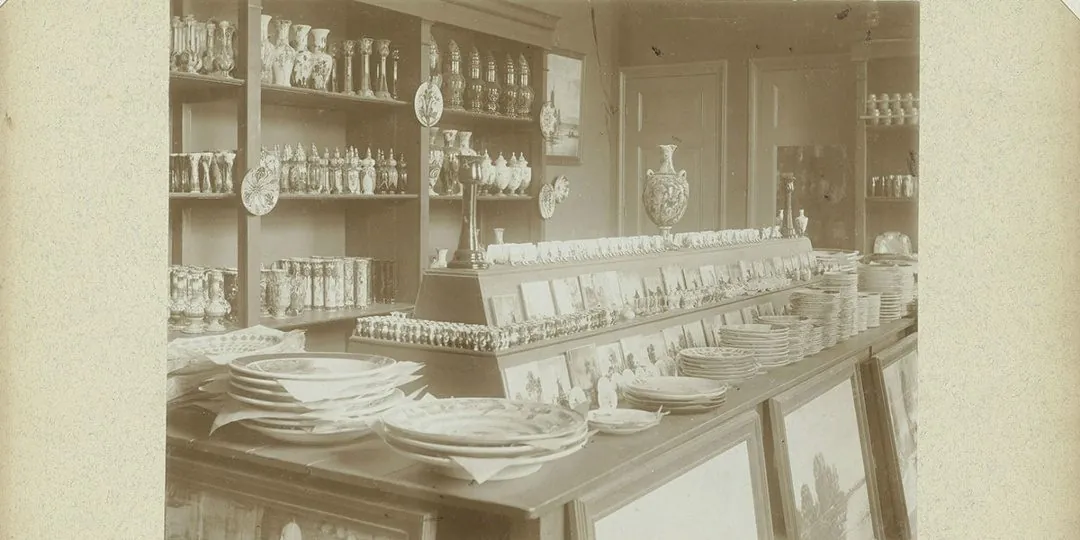
Rozenburg's wares.
Let us keep looking at the cup.
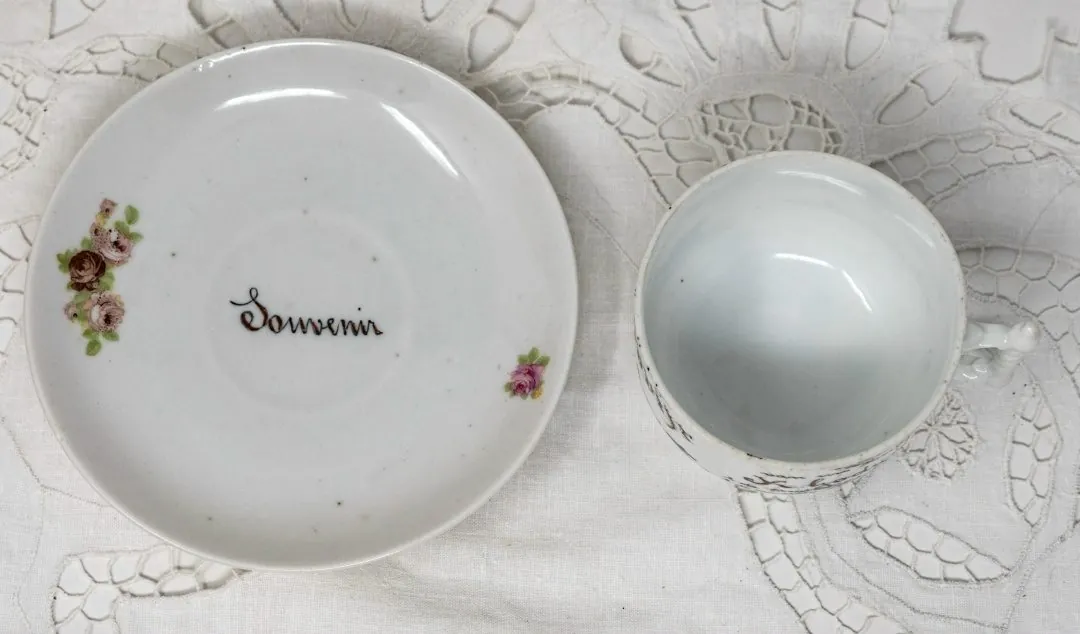
A floral transfer, and the word "Souvenir" written by hand.
What is on the underside of the cup? Nothing. But on the saucer there is some handwriting.
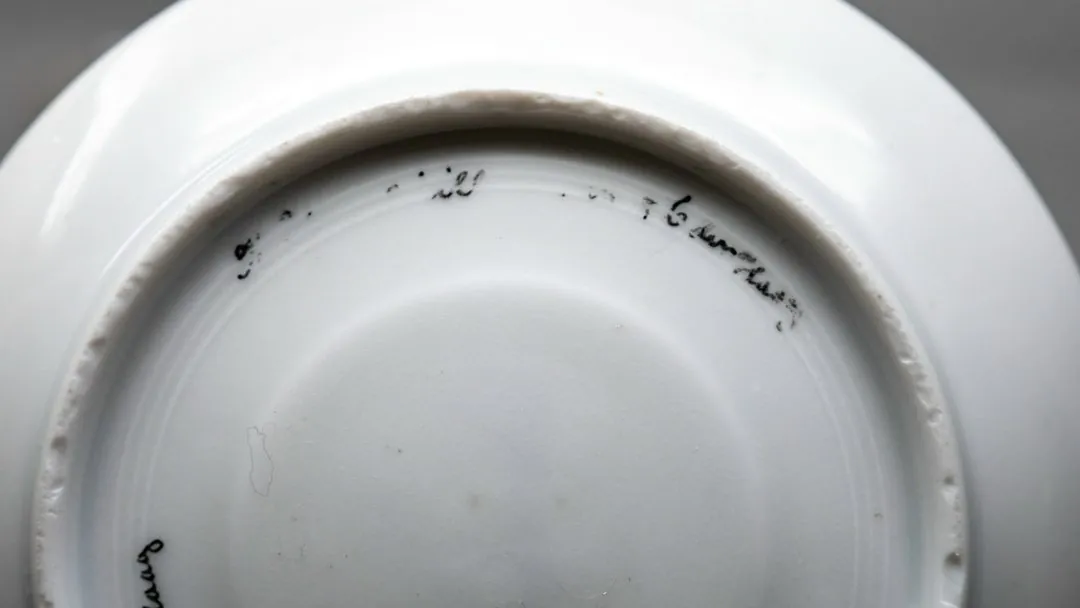
This part is damaged past reading.
And the second part has survived perfectly.
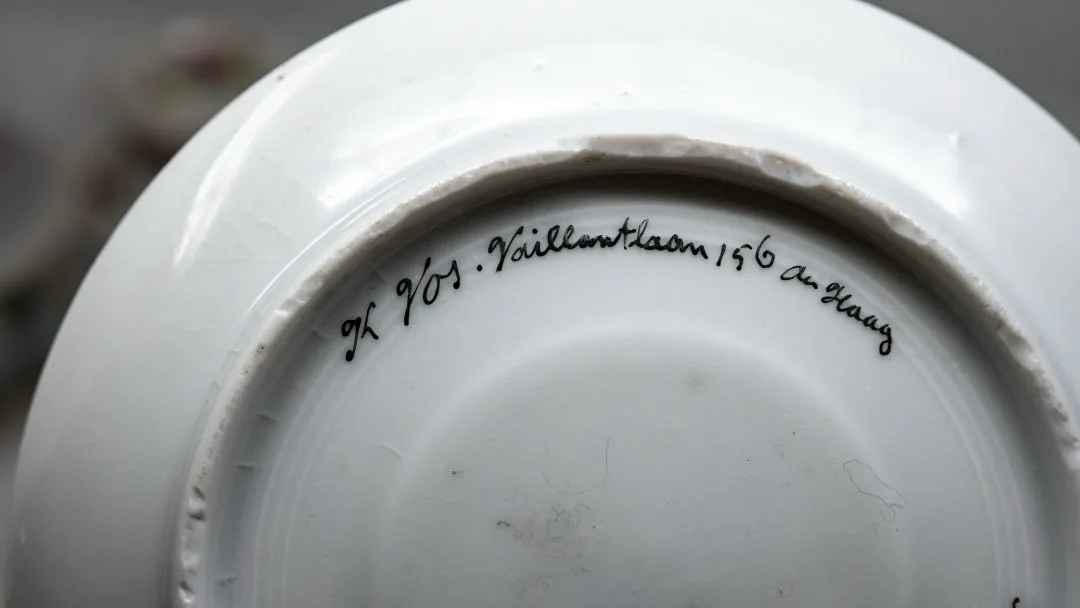
K. Vos, Vaillantlaan 156, The Hague.
Well then. Better already. K. Vos is either the painter or the owner of the souvenir shop, and quite possibly both. Working at Vaillantlaan 156.
We dig deeper.
Vaillantlaan is a street in The Hague. It has an extremely interesting history, which you can read up online, but in short: hastily filled in, with no planning to speak of. Poor people lived there, and since then very little has changed, even though the street sits practically beside the city centre.
Here is the interesting part, though: the street lies in the Schilderswijk quarter. The name translates simply as "the painters' quarter". Things are becoming clearer.
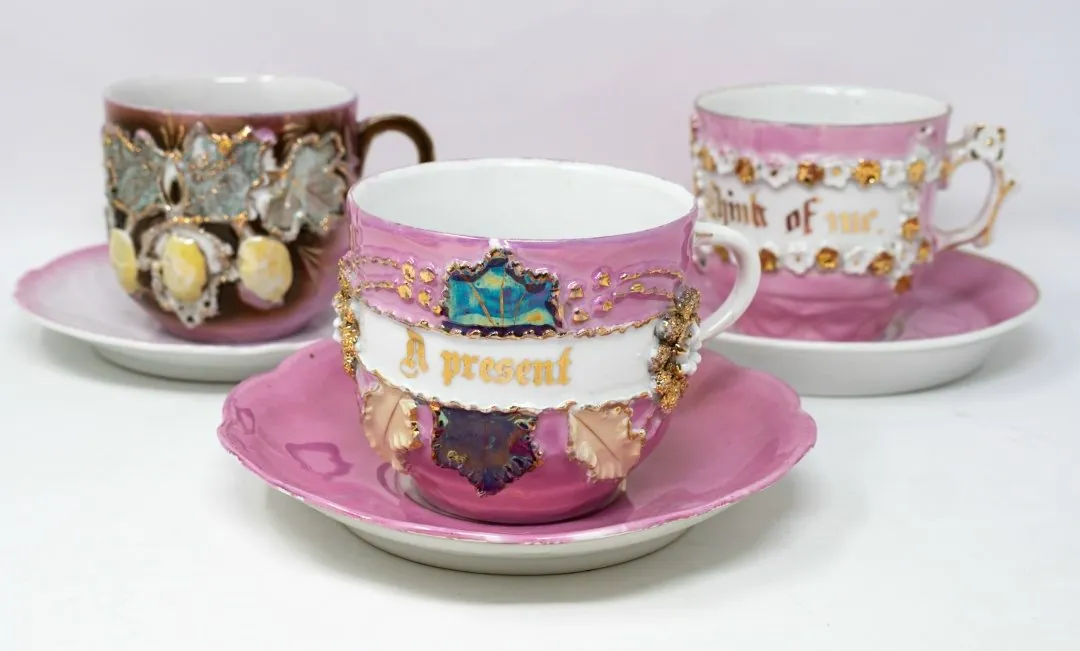
Souvenir cups mass-produced by German manufactories.
Souvenir cups are not rare. But they are faceless, like tourist fridge magnets turned out for the masses. "A gift", "Think of me", "Love" and so on are widely known and there is little to say about them — they were impersonal presents.
Our cup is not one of those. It is a rarity among rarities: an exceptionally personal porcelain "postcard" in the shape of a cup, carrying both a declaration of love and the reason for a parting. And it was very nearly thrown in the bin in Ontario, Canada. There will be another piece about the fate of the cup and the people bound up with it, as soon as new facts, data and opinions have been gathered.
I have written for comment to several places, including three Dutch museums. I very much hope they know more than the reader of these lines, and than I do. Because this cup gives me no peace. I have spent dozens of hours searching for these people, and so far the search has come to nothing — but I am not giving up.
Open questions:
Who made this cup, and when? It is certainly a European manufactory, and the cup is porcelain. Who had a handle as lovely as this one?
Who was the painter K. Vos, working in The Hague? Where did they get cups to paint? What else did they do — was there a souvenir shop? Or did our gallant soldier buy a blank and bring it to a painter, asking for words of love to be written on it?
Who were K. Godÿn and his beloved Geertruida de Booij, and who emigrated to Canada with them? Might the cup have been brought over by their children, while they themselves died in the Second World War? Might Geertruida have come to Canada alone, her husband missing?
Who made keepsake cups like this, and where, and when? This is the first time I have held one. There is a single mention online, where somebody was looking for relatives of the people named on a similar cup — but that one marked a birthday.